
Top 15 Conditions That May Require Physiotherapy Services
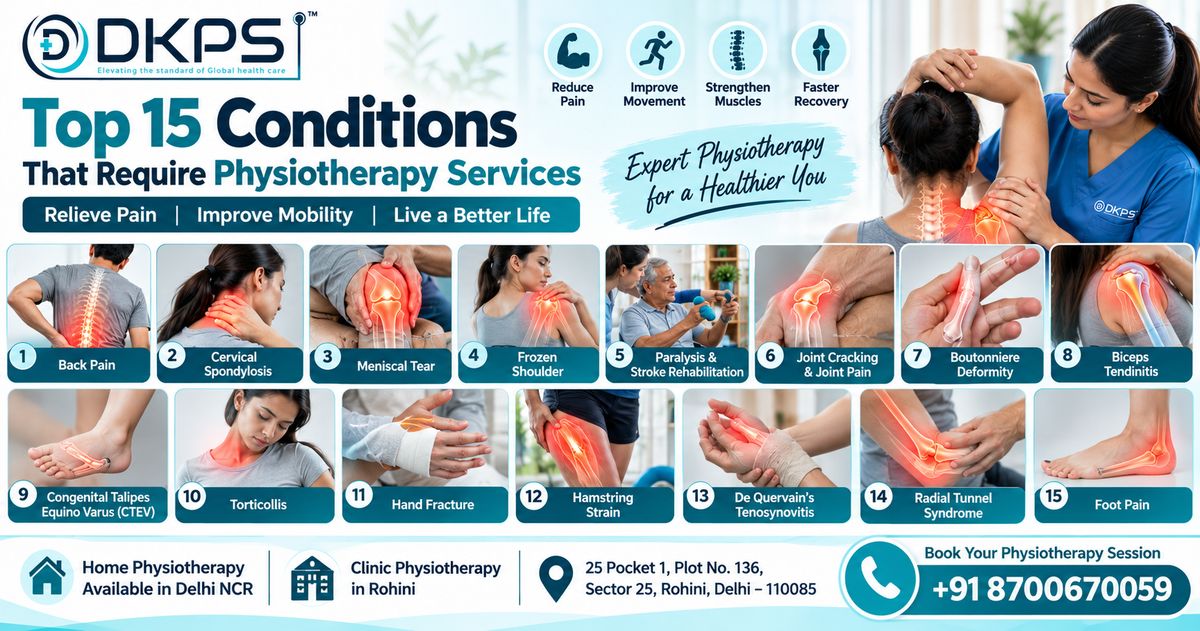
Physiotherapy is not only for sports injuries or back pain. It can also be an important part of rehabilitation for many conditions affecting the muscles, joints, bones, nerves, movement and daily activities.
A physiotherapist first looks at the person's symptoms, movement, strength, flexibility and functional limitations. Based on the condition, treatment may include exercise therapy, mobility training, strengthening, stretching, balance exercises, manual techniques and rehabilitation guidance.
Below are 15 common conditions where physiotherapy may be included as part of rehabilitation.
1. Back Pain
Back pain can affect people of almost any age. Long sitting hours, poor posture, physical work, lifting, muscle strain and injuries can contribute to back discomfort.
Some people experience difficulty sitting, standing, walking or bending because of pain.
Physiotherapy may focus on improving mobility, strengthening supporting muscles and teaching safe movement.
👉 Learn more about Back Pain: Causes, Symptoms and Treatment.
2. Cervical Spondylosis and Neck Problems
Cervical spondylosis is associated with age-related changes in the cervical spine. It may cause neck stiffness, discomfort and reduced movement.
People who spend many hours working on computers or using mobile phones may also experience neck and upper-body discomfort.
Depending on the condition, physiotherapy may include neck mobility exercises, strengthening, posture education and other rehabilitation techniques.
👉 Read more about Cervical Spondylosis.
3. Meniscal Tear
The meniscus is a piece of cartilage in the knee that helps with load distribution and joint movement. A meniscal tear can occur after a twisting injury or as a result of degenerative changes.
Possible symptoms include:
Knee pain
Swelling
Stiffness
Difficulty bending or straightening the knee
Problems with walking or certain activities
Physiotherapy may be part of rehabilitation depending on the type and severity of the injury and the treatment recommended by the healthcare professional.
👉 Learn more about Meniscal Tear and Physiotherapy.
4. Frozen Shoulder
Frozen shoulder can cause significant shoulder pain and stiffness. People may find it difficult to raise their arm, reach behind their back or perform everyday activities.
Physiotherapy commonly focuses on gradually improving shoulder movement and maintaining or rebuilding function.
Treatment should progress according to the person's pain level, mobility and overall condition.
👉 Read more about Frozen Shoulder.
5. Paralysis and Stroke Rehabilitation
After a stroke, some people may experience weakness, difficulty walking, poor balance or problems using one side of the body.
Physiotherapy can be an important part of rehabilitation. The therapist may work on:
Muscle strength
Balance
Walking
Coordination
Transfers
Functional movements
Independence in daily activities
Stroke rehabilitation should be personalised because every patient's recovery needs are different.
👉 Explore Paralysis and Stroke Physiotherapy.
6. Joint Pain and Joint Cracking
Joint sounds such as clicking or cracking can occur for different reasons. A joint sound alone does not necessarily mean that there is a serious problem.
However, if cracking is accompanied by pain, swelling, stiffness, weakness or reduced movement, an assessment may be useful.
Physiotherapy may help improve strength, mobility and functional movement when an underlying musculoskeletal problem is present.
👉 Read What Is Joint Cracking? to understand more.
7. Boutonniere Deformity
Boutonniere deformity is a condition affecting the finger in which the middle joint can develop a characteristic bending position.
It can occur after an injury to structures supporting the finger joint.
Hand rehabilitation may be important for maintaining movement and function. Depending on the cause and stage of the condition, therapy may involve carefully planned exercises and functional training.
👉 Learn more about Boutonniere Deformity.
8. Biceps Tendinitis
Biceps tendinitis involves irritation or inflammation affecting the biceps tendon, commonly around the shoulder.
It may cause pain at the front of the shoulder, particularly during activities involving lifting or raising the arm.
Physiotherapy may focus on:
Restoring shoulder movement
Improving muscle strength
Gradual return to activities
Correcting movement patterns
Managing load on the affected area
👉 Read more about Biceps Tendinitis.
9. Congenital Talipes Equino Varus (CTEV)
Congenital Talipes Equino Varus, commonly known as clubfoot, is a condition present from birth in which the foot has an abnormal position.
Management can involve a combination of medical and rehabilitation care depending on the child's individual condition and treatment plan.
Physiotherapy may support mobility, muscle function and rehabilitation when recommended as part of the child's overall care.
👉 Learn more about Congenital Talipes Equino Varus (CTEV).
10. Torticollis
Torticollis is a condition in which the head and neck may appear tilted or turned to one side.
It can occur in children or adults for different reasons. Some cases involve muscle tightness or restricted neck movement.
Physiotherapy may include appropriate stretching, positioning, movement exercises and strengthening depending on the underlying cause and the person's age.
👉 Read more about Torticollis.
11. Hand Fracture Rehabilitation
A hand fracture can affect grip, finger movement, strength and everyday activities.
After the fracture has been appropriately managed and when rehabilitation is medically suitable, physiotherapy or hand therapy may help restore:
Range of motion
Grip strength
Finger movement
Hand function
Coordination
The timing and type of exercises should follow the treating doctor's or therapist's recommendations because rehabilitation depends on the type and stage of fracture healing.
👉 Read more about Hand Fracture Rehabilitation.
12. Hamstring Strain
The hamstrings are muscles located at the back of the thigh. A strain can occur during running, jumping, sports or sudden movements.
Symptoms can include:
Pain at the back of the thigh
Muscle tenderness
Difficulty walking or running
Reduced flexibility
Weakness
Physiotherapy can help guide a gradual return to movement and activity. Rehabilitation may include flexibility, strengthening and progressive functional exercises.
👉 Learn more about Hamstring Strain.
13. De Quervain's Tenosynovitis
De Quervain's tenosynovitis affects tendons on the thumb side of the wrist. Repetitive hand and wrist movements can contribute to symptoms.
A person may experience:
Wrist pain
Thumb-side tenderness
Difficulty gripping
Pain while moving the thumb
Discomfort during repetitive activities
Depending on the person's condition, rehabilitation may include activity modification, exercises and other appropriate therapeutic techniques.
👉 Read more about De Quervain's Tenosynovitis.
14. Radial Tunnel Syndrome
Radial tunnel syndrome involves irritation or compression affecting the radial nerve around the elbow and forearm region.
It may cause pain around the outer elbow or forearm and can become more noticeable during repetitive arm activities.
Physiotherapy may focus on movement, strengthening, activity modification and rehabilitation according to the individual's symptoms.
👉 Learn more about Radial Tunnel Syndrome.
15. Foot Pain
Foot pain can have many possible causes, including injury, overuse, changes in movement, footwear-related stress or other musculoskeletal problems.
Persistent foot pain may affect walking and can sometimes change the way a person moves.
Physiotherapy may help assess movement, flexibility, strength and walking patterns and provide an appropriate rehabilitation program.
👉 Read more about Foot Pain: Causes and Treatment.
How Does Physiotherapy Help With These Conditions?
Physiotherapy is not the same for every patient. Treatment is usually selected according to the condition, symptoms, physical ability and rehabilitation goals.
Depending on the problem, a physiotherapist may use:
Exercise Therapy
Specific exercises can help improve muscle strength, flexibility, mobility and physical function.
Mobility Training
Patients with stiffness or restricted movement may receive exercises designed to gradually improve mobility.
Strengthening Exercises
Weak muscles can affect posture, balance and everyday movement. Progressive strengthening may help improve functional ability.
Balance and Coordination Training
These exercises can be useful for selected patients with balance or movement difficulties.
Manual Therapy
Hands-on techniques may be included when considered appropriate for the patient's condition.
Functional Rehabilitation
The focus may be on practical activities such as walking, climbing stairs, using the hand, reaching, lifting or returning to sport.
Why Is an Assessment Important Before Physiotherapy?
Two people can have similar pain but completely different underlying problems.
For example, knee pain could be associated with a meniscal problem, muscle weakness, injury or another condition. Similarly, shoulder pain could have several possible causes.
An assessment helps the physiotherapist understand:
Where the problem is located
What movements are restricted
Whether there is weakness
How the condition affects daily activities
What type of rehabilitation may be appropriate
This is why copying exercises from the internet is not always suitable for every patient.
When Should You See a Doctor?
Physiotherapy can be useful for many rehabilitation needs, but some symptoms require medical evaluation first.
Seek appropriate medical attention for symptoms such as:
Severe or sudden pain
Major injury or accident
Sudden weakness
New loss of sensation
Difficulty speaking
Sudden loss of balance
Loss of bladder or bowel control
Severe swelling
Symptoms that are rapidly getting worse
A physiotherapist can work as part of a broader healthcare team when medical assessment or other specialist care is needed.
Who Can Benefit From Physiotherapy?
Physiotherapy may be useful for people recovering from:
Musculoskeletal injuries
Sports injuries
Surgery
Fractures
Neurological conditions
Joint problems
Muscle strains
Mobility difficulties
It can also help people who want to improve strength, movement and physical function after an injury or period of reduced activity.
Physiotherapy at Home
For patients who have difficulty travelling to a clinic, home physiotherapy can be a convenient option where available.
Home-based rehabilitation may be particularly useful for elderly patients, people recovering after surgery, patients with mobility limitations and people who require regular rehabilitation.
Treatment should still be based on an appropriate assessment and an individual treatment plan.
Why Choose Dr Singh Physiocare?
Choosing a physiotherapy provider should be based on the patient's condition, treatment requirements and the qualifications and experience of the healthcare professional.
Dr Singh Physiocare provides physiotherapy and rehabilitation services for a range of musculoskeletal and functional conditions.
The treatment approach can be adapted according to the patient's:
Condition
Pain and symptoms
Movement limitations
Muscle strength
Functional requirements
Rehabilitation goals
The focus is on helping patients work towards better movement and improved day-to-day function.
Frequently Asked Questions
1. What conditions can physiotherapy treat?
Physiotherapy can be part of rehabilitation for many conditions involving muscles, joints, bones, nerves and movement. Examples include back pain, cervical problems, knee injuries, frozen shoulder, stroke rehabilitation, muscle strains and hand or wrist conditions.
2. How do I know whether I need physiotherapy?
If pain, stiffness, weakness or reduced movement is affecting your normal activities, an assessment can help determine whether physiotherapy may be appropriate.
3. Can physiotherapy help after a fracture?
Yes, rehabilitation may help restore movement, strength and function after a fracture once the injury has been medically managed and the patient is ready for rehabilitation. The timing depends on the fracture and healing stage.
4. Is physiotherapy useful after a stroke?
Physiotherapy can be an important part of stroke rehabilitation, particularly for problems involving strength, balance, walking and functional movement. The program should be individualised according to the patient's condition.
5. Can I receive physiotherapy at home?
Home physiotherapy may be available depending on your location and the required service. It can be useful for patients who have difficulty travelling to a clinic or require rehabilitation at home.
Conclusion
Physiotherapy can play an important role in rehabilitation for many different conditions—not just back pain or sports injuries.
From cervical spondylosis, meniscal tears and frozen shoulder to stroke rehabilitation, hand fractures, hamstring strains, foot pain and nerve-related conditions, treatment should be based on the individual's symptoms and functional needs.
The most important step is to understand the underlying problem before starting a treatment program. A qualified physiotherapist can assess movement and develop an appropriate rehabilitation plan.
If you are experiencing pain, stiffness, weakness or difficulty with movement, consider getting a professional assessment to understand whether physiotherapy is suitable for your condition.
Targeted Service Locations for this Therapy
AI Precision Recovery Roadmap
Our structured recovery pathway ensures accurate diagnostics and active care beyond clinic doors.
1. Assess
AI + Physio Precision
2. Plan
Smart-Goals Pathway
3. Track
Proof of Progress
4. Advance
Care Beyond Clinic
Watch Video Guide
Article Info
Author
Dr Kp Singh - MPT Orthopaedics joint muscles and spine specialist
Follow DKPS PhysioCare
Stay connected with us for health tips, rehabilitation guides & live updates.
Recommended Specialists
Consult with our licensed senior therapists for a personalized treatment roadmap.

































Active Healing
Need Specialized Physiotherapy?
Book a home visit or clinic consultation with our senior specialist doctors for a personalized diagnosis.